The “Face of Kenya” Glitch: Why SHA’s Unverified Appointments are Lighting Up Social Media

The rollout of Kenya’s Social Health Authority (SHA)—the cornerstone of President Ruto’s Universal Health Coverage (UHC) vision—has hit a significant political “glitch.” A viral, unverified list purporting to name the 47 County Operations Managers has triggered a firestorm of accusations regarding ethnic favoritism. Critics, including vocal Member of Parliament Caleb Amisi, are flagging what they describe as a “skewed” recruitment architecture that fails to reflect the “Face of Kenya.”
The controversy stems from a data analysis of the leaked list, which suggests that individuals of Somali heritage occupy roughly 25% of the management slots. When benchmarked against the national population, where this group represents approximately 6%, detractors argue the “backend” of the SHA’s human resource system is heavily unbalanced. This perceived over-representation has amplified fears that the transition from the NHIF to the SHA is being marred by the same “legacy bugs” of tribalism and nepotism that have plagued previous state agencies.
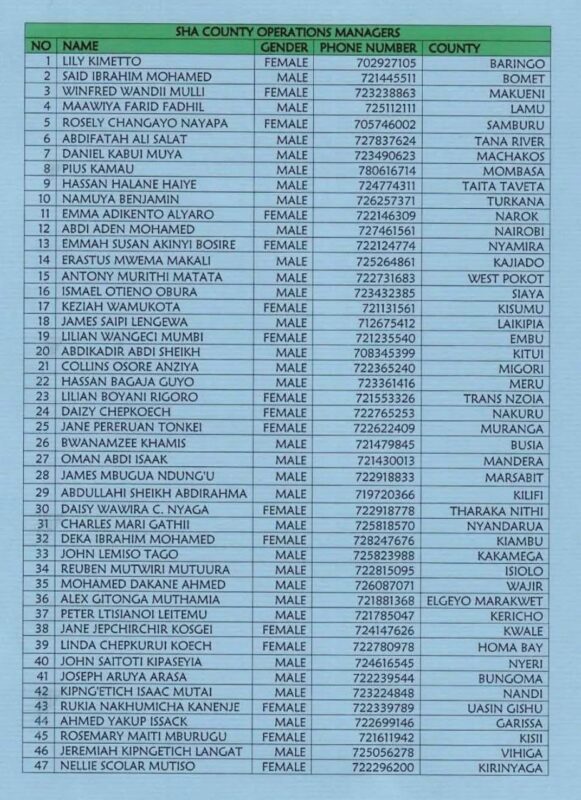
As of late January 2026, the document remains in a “beta state”—neither the Ministry of Health, led by CS Aden Duale, nor the official SHA portal has confirmed its authenticity. While some government supporters defend the list as a result of a merit-based, competitive recruitment process, others have labeled it a total fabrication designed to sabotage the SHA’s rollout. This lack of a “verified badge” from official channels has allowed speculation to dominate the digital conversation on platforms like X (formerly Twitter) and Reddit.
This “identity crisis” comes at a critical time for the SHA’s infrastructure. The authority is currently managing a massive migration, recently onboarding over 400,000 teachers and the National Police Service onto the new health financing framework. However, the operational “uptime” has been shaky; many Level 2 and Level 3 hospitals report they haven’t received payments for over six months, forcing some to “offline” their pharmacy and laboratory services. The management list controversy only adds a layer of political instability to these existing technical and financial bottlenecks.
For the Ruto administration, the SHA is the flagship product of the “Bottom-Up” agenda. To ensure the “system” doesn’t crash under the weight of public distrust, there are growing calls for a transparent audit of the recruitment process. Experts suggest that for the SHA to achieve its “Universal” mandate, its leadership must be as diverse as the user base it serves. Without a clear “patch” in the form of official communication and equitable distribution of roles, the SHA risks losing the social capital needed to sustain the most ambitious health reform in Kenya’s history.