Muhoozi Sets 2031 Target, Predicts 90% Vote With Museveni’s Backing

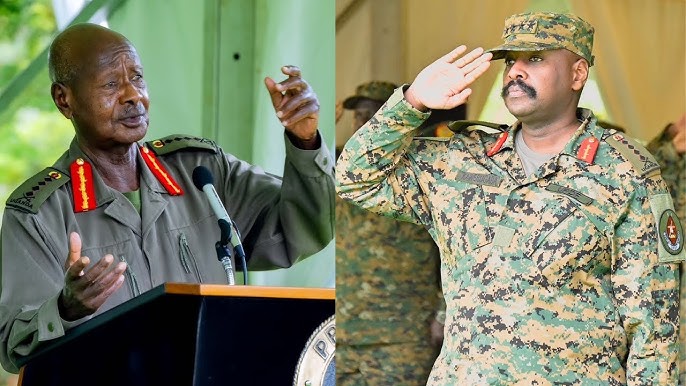
Uganda’s political succession debate has gained fresh momentum after Chief of Defence Forces Gen Muhoozi Kainerugaba openly projected himself as a strong contender for the presidency in 2031, predicting an overwhelming victory if he receives the backing of his father, President Yoweri Museveni.
Muhoozi made the bold prediction on Wednesday, August 26, 2026, in a post on X, where he shared a photograph of himself with Museveni.
“With my great father, Mzee’s, support I will get 90% in the elections in 2031,” he wrote.
The statement comes only days after Muhoozi made his presidential ambitions more explicit, saying he intends to seek Uganda’s highest office in the 2031 election.
Although Muhoozi has for years been mentioned in discussions about who could eventually succeed Museveni, his latest statements represent a more direct indication that he is preparing for a future presidential contest.
Museveni has been Uganda’s president since 1986 and remains the country’s dominant political figure. His eventual departure from power has therefore been a major subject of political debate, with Muhoozi frequently emerging as one of the names associated with the succession question.
Muhoozi’s political profile has expanded alongside his military career. He currently serves as Uganda’s Chief of Defence Forces, while his Patriotic League of Uganda (PLU) has continued building a grassroots political network.
The movement’s renewed mobilisation following the 2026 elections could provide Muhoozi with an organisational base if he eventually proceeds with his presidential ambitions.
However, the road to State House is unlikely to be straightforward.
A recent study published in African Affairs found that Muhoozi remains less popular among surveyed Ugandans than his father. According to the study, 35 per cent of respondents approved of Muhoozi compared with 54 per cent for Museveni.
The figures suggest that while Muhoozi has considerable political visibility, converting that profile into broad national support could remain a significant challenge.
His prediction of a 90 per cent vote therefore sets an exceptionally high benchmark for a political career that is still developing.
Muhoozi’s declaration also comes against the backdrop of continuing concerns over political competition and democratic freedoms in Uganda.
Musician-turned-politician Bobi Wine, who contested the 2026 presidential election against Museveni, is currently in the United States amid concerns over his possible arrest should he return to Uganda.
Bobi Wine has repeatedly accused the government of using state agencies to intimidate and suppress opposition figures and supporters. His political camp has also raised concerns over arrests and threats involving opposition activists.
The situation has revived memories of the prolonged legal and political battles involving veteran opposition leader Kizza Besigye, who has spent extended periods in detention and faced charges after challenging Museveni’s government.
Against this background, Muhoozi’s potential presidential bid is likely to generate renewed debate over the nature of Uganda’s political transition.
If Muhoozi ultimately contests in 2031, the election could become a crucial test of whether Museveni’s political influence can be transferred to his son and whether the opposition can mount a sufficiently strong challenge.
For now, Muhoozi’s 90 per cent prediction has placed him at the centre of Uganda’s succession conversation, years before the next presidential vote.