
Oscar Sudi’s Nature-Friendly School Sparks Clash with Ndindi Nyoro’s Paved Style


The battle for constituency supremacy in Kenya has moved beyond mere construction to a clash of architectural philosophies. Kapseret MP Oscar Sudi has sparked a viral conversation across social media after unveiling a major facelift of a rural school in Uasin Gishu County. While the upgrades—funded by the National Government Constituency Development Fund (NG-CDF)—were meant to showcase progress, they have instead triggered a national debate on the most effective way to modernize educational facilities as the 2027 elections draw near.
Oscar Sudi, who often emphasizes his background in engineering and design, unveiled the newly renovated school by highlighting its “nature-friendly” aesthetic. In a departure from the modern trend of heavy concrete usage, Sudi’s project features lush green lawns and preserved indigenous trees. He argued that maintaining an organic, serene environment is more conducive to a calm learning atmosphere in rural settings, intentionally choosing to avoid the “cabro” paving that has become a status symbol in other high-performing constituencies.
However, the “green” approach has invited immediate comparisons to Kiharu MP Ndindi Nyoro, whose signature school projects are famous for their fully paved compounds. Nyoro’s supporters argue that paving is a practical necessity in the Kenyan climate to eliminate the twin problems of dust during the dry season and mud during the rains. This “pavement vs. grass” debate has become a proxy for a much larger discussion on long-term maintenance: while Sudi’s fans claim his design preserves the dignity of the countryside, critics argue that maintaining a lawn in a public school is an expensive and difficult task compared to the one-time cost of paving.
While many celebrated the fresh look of the Kapseret schools, the project has not escaped scrutiny. Skeptics on social media have demanded a full breakdown of the costs involved, with some dismissing the upgrades as “superficial.” The argument from critics is that a fresh coat of paint and some landscaping, while visually pleasing, do not address the core structural needs of rural schools, such as modern laboratories, computer hubs, and adequate housing for teachers.
This scrutiny is further intensified by Sudi’s recent run-ins with professional bodies. The Engineers Board of Kenya (EBK) has previously questioned the use of the title “Engineer” in his honorary doctorate, adding a layer of skepticism to the debate. Opponents have questioned whether the “nature-friendly” design is a genuine engineering choice or simply a cost-cutting measure disguised as an aesthetic one to save on CDF expenditures ahead of a high-stakes political season.
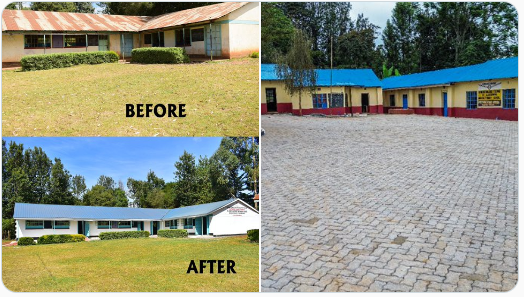
The conversation on X (formerly Twitter) has been a polarized mix of praise and pragmatism. Supporters like @NairobiObserver championed the move, noting that schools shouldn’t look like “parking lots” and that children deserve natural spaces to play, while others like @Techie_Ke dismissed the project as mere “paka rangi” (painting), questioning how students will navigate the mud of Uasin Gishu without paving. The debate also touched on economic sustainability, with @Mama_G_Nyeri pointing out that public schools often lack the budget to maintain pristine lawns, making Nyoro’s “cabro” approach more durable. Amidst the bickering, voices like @RuralVoice urged for perspective, noting that both MPs are delivering more than those who vanish with CDF funds, though accounts like @TheEconomistKE maintained that without a published Bill of Quantities (BQ), it is impossible to know if taxpayers are getting true value for their money or just a 2027 PR campaign.